Blog
Beyond the Ghost Patient: Why Patients Really Choose a GLP-1

Adam Zandman
Marketing Director
Insights

A 66-year-old afraid of a diagnosis and a 41-year-old who wants to quiet the food noise can be on the same weekly shot. If you're planning a launch, which one is your patient? The answer may be both, or only a slice of one, and that’s the problem with building a brand plan around a single patient profile. Two people who look alike on paper can want very different things from the same drug.
A 66-year-old afraid of a diagnosis and a 41-year-old who wants to quiet the food noise can be on the same weekly shot. If you're planning a launch, which one is your patient? The answer may be both, or only a slice of one, and that’s the problem with building a brand plan around a single patient profile. Two people who look alike on paper can want very different things from the same drug.
Thrivable 365’s Q4 2026 survey asked 743 people who are taking a GLP-1 for weight management, have taken one, or are considering starting one a different question: what do they need the medication to do? That approach revealed four preliminary segments that demographics alone may miss.
So where do we go from here? We have one take away and also a next area for future inquiry. The main takeaway based on our data is that a patient’s position in the treatment journey is currently the most important factor to look at.
The oral GLP-1 patient we couldn't find
In brand-planning conversations, the oral patient is often pictured as younger, price-sensitive, and someone who would rather avoid needles. In Q3, we looked for that person among 605 GLP-1-naive and experienced respondents.
We couldn't find them, and the "pill patient" turned out to be more of a ghost than a persona. Age, BMI, and sex did little to separate who would consider an oral, and it turns out that a patient's place in their treatment journey made the real difference.
That finding, that journey stage mattered more than demographics, changed the question we asked next. In Q4, our report Hired, Fired, Rehired: What WMM Patients Need Next stopped asking who the patient is and started asking what they’re hiring a GLP-1 to do.
Four reasons patients turn to a GLP-1
We built the survey around jobs-to-be-done, a framework popularized by Clayton Christensen that looks at what people “hire” a product to do for them. Grouping respondents by what they need most from the medication gave us four preliminary segments:
- Diagnosis-Driven: managing a condition they already have
- Watchful & Worried: heading off a future health problem
- Cycle Breakers: losing weight and keeping it off after other attempts failed
- Confident Optimizers: losing weight without trading away future health
Respondents rated and ranked more than 50 functional, emotional, and social needs to get there, and the reasons are often personal. As one patient told us:
“Yo-yo weight. I had lost 100 pounds and for 4-5 years I was up and down 35-45 pounds over and over.”
– Current User, Female, 48
About two-thirds of respondents look like the market GLP-1s were originally built for. The rest behave more like consumers, and we expect them to shape what comes next. It’s one of the clearest examples we’ve seen of the consumerization of healthcare: the people who started treatment earliest were more often heavier, living with diabetes and insured, while more recent starters tend to be younger and lighter, are more likely to pay cash, and are focused mainly on the weight itself.
For anyone launching in the next few years, that split will matter more as the field gets crowded. As Thrivable founder and CEO David Edelman put it in September, “When there’s five, when there’s 10, when there’s 20, the market fragments. You can’t advertise everything in the grocery store to everybody.”
The fear behind the ghost patient
The pill patient was pictured as someone who wants to avoid needles, but our data points to a different barrier. How a drug is taken matters less than you might expect. In our Q3 report, format accounted for just 8% of patients’ decision, and Q4 points the same way: about half of current and former users rate features like needle-free, no fasting, or a pill or patch as important, but each gets only 1 to 9% of their top-three picks for what would pull them to a new option. What may hold more people back is fear of side effects. In Q4, people who had never taken a GLP-1 were three times as likely to worry about a side effect as users were to report a moderate or severe one.
Experienced users rarely report the side effects naive patients fear, and many find the reality more manageable than they expected. One former Ozempic user told us that once they tried the injections, “it wasn’t as bad as I thought it might be,” and they stayed on treatment with good results.
For people who haven’t started yet, that fear is still in the way, especially in the segment we call Watchful & Worried. They are the most cautious of the four, with fear of what’s coming motivating them as much as the weight itself. One GLP-1 naive respondent put it plainly:
“I would start a WMM pill 100% if there were no side effects. I’m very concerned with the side effects.”
– Naive respondent, Male, 53
Their treatment choices back this up. Among current users, Watchful & Worried patients are the most likely of the four segments to be on an oral, and a more tolerable medication or a weekly pill is more likely to draw them to a new option than it is for any other segment. Confident Optimizers sit at the other end: they’re the least likely to take an oral, and they care most about lasting, healthy weight loss from treatment.
So the oral patient may not be a demographic at all. For a group like this, the appeal of a pill may have less to do with avoiding needles and more to do with feeling confident enough to start. Reaching them means leading with tolerability and reassurance over convenience, a different message than the “traditional pill patient” profile would suggest.
What this means for your launch strategy
The ghost patient reminds us that the profile on the whiteboard and the people actually in the market can be very different. For teams preparing a commercial launch, closing that gap comes down to changing how you plan in two ways.
Start with the need your asset meets best, then find those people in the market.
Demographics still matter for planning, but as Clickspring Collective’s Belinda Mulhern put it, they "become more of an execution decision." The strategic question is which need your product is built to meet, and who has that need today.
Plan for patient needs to change over time, not just at launch.
Weight loss tends to level off in our data around 18 months, and 43% of former users plan to restart. A launch plan built on a single snapshot of the patient can be out of date by the time it reaches the market.
Patients aren’t the only ones carrying a fear in this market. For a brand team launching into a category that’s changing this quickly, the risk is building a plan around a patient who isn’t there. What eases that fear is what eased it for the patient who tried injections: experience. For a brand, that means hearing from patients directly and often, which is why we go back to them every quarter.
The full report sizes all four segments and shows what each one values, what they’d pay, and what makes patients stop, switch or restart.
Download the Q4 2026 Thrivable 365 Report Summary
Or, if you would like to join us in this endeavor, connect with Thrivable to request your readout once our next wave of Thrivable 365 data drops.
About the data: Thrivable 365 Q4 2026 surveyed 743 respondents from Thrivable's 140,000-member cardiometabolic patient panel: 379 current, 152 former and 212 who have never taken a GLP-1 but have some interest in starting. Fielded September 26 to October 8, 2026. Results are unweighted and directional.
About the author
Adam Zandman
Marketing Director
Adam, Thrivable's Marketing Director, is a passionate advocate for improving the patient experience, driving companies to prioritize the patient voice in their decisions
Related Content
-

-

-
White Paper
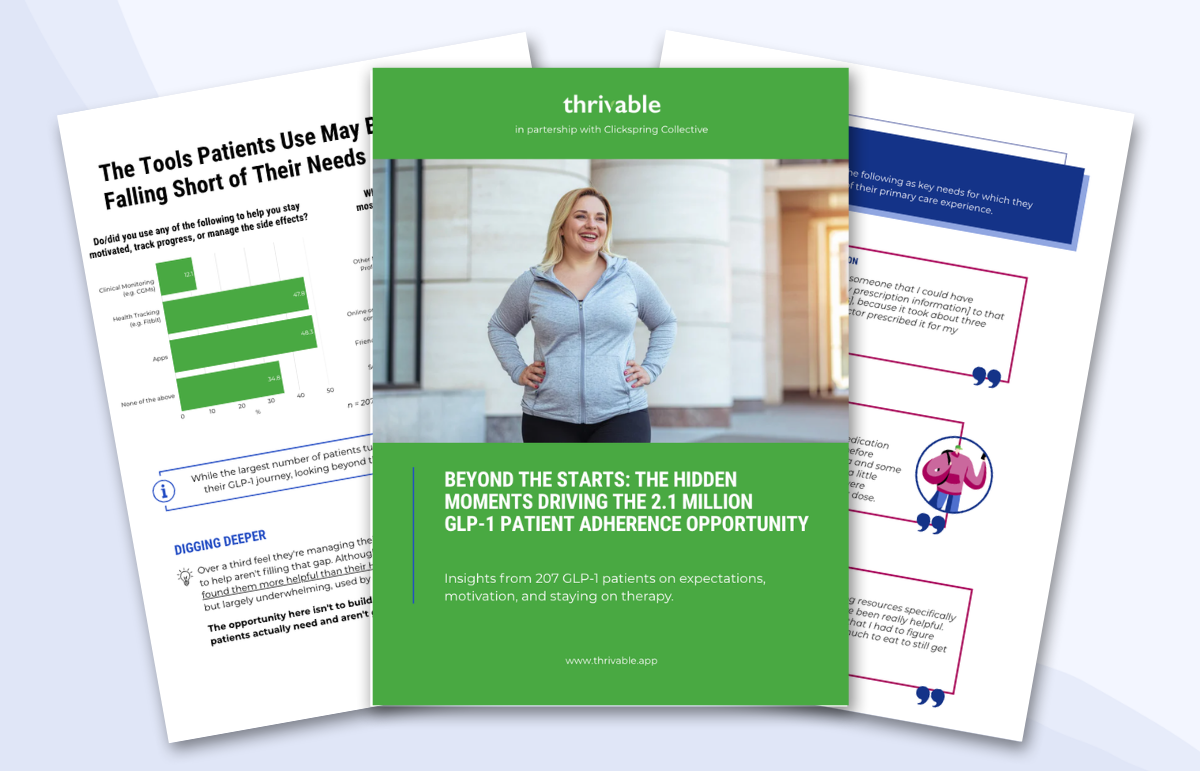
Beyond the Starts: The Hidden Moments Driving 2.1 Million GLP-1 Patient Adherence Opportunity
White Papers